
European hornets in a bird box
Last year, we had Great Tits nesting in our bird box, and despite some interest from the same species this year around Easter, they didn’t use our prime real estate to raise a family; maybe the resident cats harassing them last year put them off.
A few weeks ago I noticed a queen hornet flying in and out, and realised she was building a nest. I really like hornets, and they are extremely efficient apex predators – I remember a friend saying their vegetable garden had not had any caterpillar damage the one year they also had a nest of hornets in the nearby orchard. However, our nestbox is right by the shed, so not great for birds or insects to use. I wanted to move the box before the colony got too large, so I dusted off my beesuit and leather gloves (ESSENTIAL KIT!) and strapped up the nestbox so I could block the entrance and take it over to my friend’s woodland where they could do their thing without causing any issues. My first attempt had to be aborted as I was just blocking up the entrance when I realised the queen was flying around, and on seeing me, turned and flew in the other direction.
I had seen more than one hornet entering the box, but I wasn’t sure whether it was a new worker, or another queen nosing around. Hornets have a life cycle like other wasps, so the queens wake from hibernating and set out to find a nest site. Once they’ve found a safe space, they gather wood pulp to construct a nest, with cells, in which they lay eggs, and continue to nurture the developing larvae until the first workers hatch, at which point the queen then stays in the nest while her daughters carry out resource-gathering duties and she stays at the nest, focussing on increasing the colony. If the queen starts off in a confined space, she will sometimes start a new nest in a larger cavity with her oldest daughters, leaving younger ones to feed and care for the remaining larvae. Once they have hatched, the first nest is abandoned. I thought this relocation might have happened, so I checked the nest, and saw that in fact it was still at the embryonic stage, with fat larvae in the cells. It was attached to the roof of the bird box, and the nest fell off when I moved the box from the fence. I know honey bees can relatively easily reorganise the nest if it gets damaged, so I’m hoping – presuming – that hornets can do the same. The queen arrived back as I was inspecting the birdbox so I hastily reattached it to the fence and got out of her way. I went and had a think about what would be best to do.

I decided that it would be wise to take the nest and the queen away to their new home before the workers started flying. Hornets are crepuscular leaning into nocturnal, but of course when the queen is having to be chief, cook, and bottle-washer, she flies throughout the day. I plugged the entrance with some sheep’s wool, sincerely hoping she hadn’t snuck out while I was deliberating on the best course of action. I didn’t dare lift the lid again in case she flew out, so crossed my fingers while I took the box gently off the wall and wrapped it in a sheet. Hoping that the larvae in their papery cells would be ok on the journey, I put the box in the boot of my car and made my way over to my friend’s property, keeping my beesuit close to hand, although with a single hornet carefully contained with her babies I wasn’t worried about having to deal with escapees.
On arrival, gently carried the box, shrouded in its sheet, and fixed it onto a tree on the edge of the woodland. I debated about trying to take the lid off and check inside but I figured I’d messed the queen around enough, and made my way back for some much-needed coffee.
European hornets really are the gentle giants of the British insect world, and it’s a great shame they get such a bad press, with lots of scaremongering and general hysteria. Along with stag beetles and hawkmoths, our charismatic arthropods are in need of respect and care as we encroach on their natural habitat. There’s an excellent website here championing our largest wasp species, and I really hope they make it. If you spot a hornet starting to make a nest in May/June in a birdbox (it’s not uncommon!) then if you, or someone you know has beekeeping experience, they are relatively straightforward to move. Unfortunately, many beekeepers single out all wasp species for extermination on the grounds that they can predate honey bees, but a strong healthy honey bee colony will easily overpower any intruder.
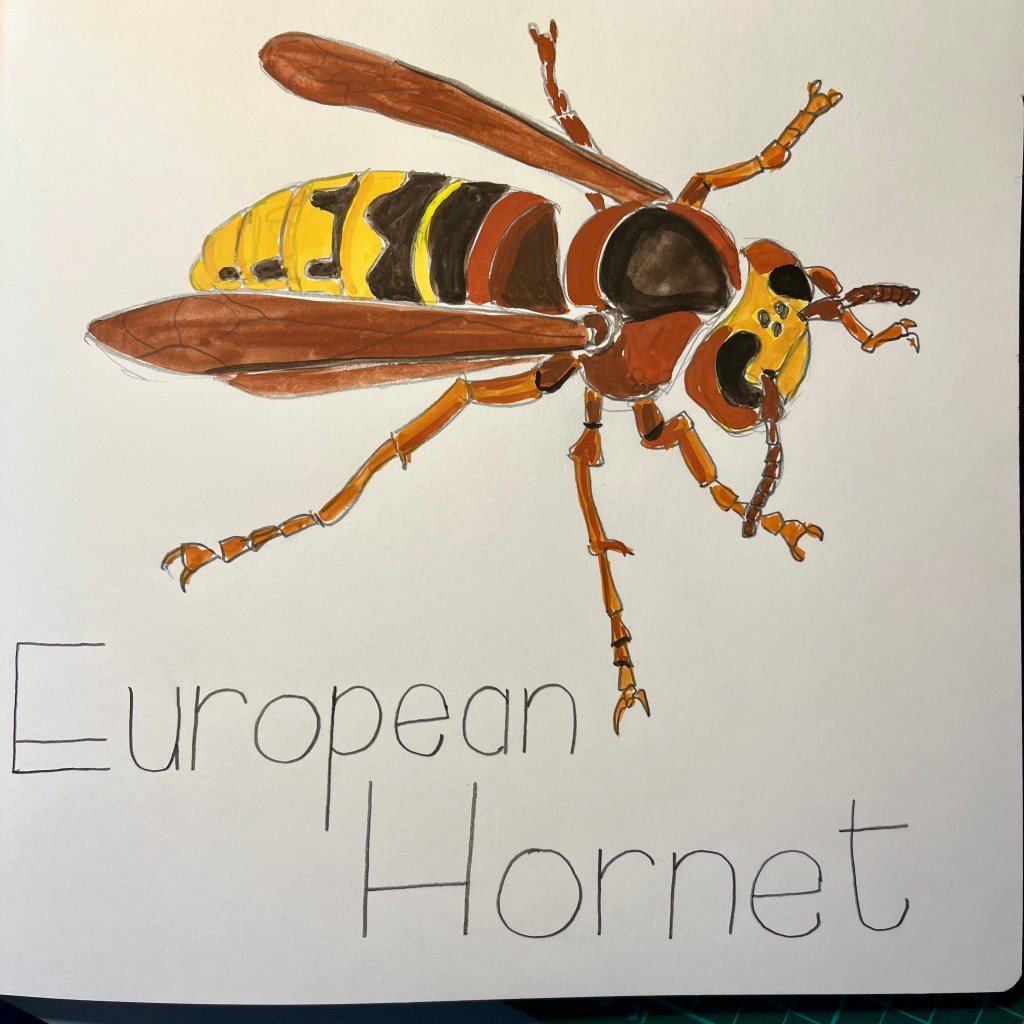
In celebration of our brief spell of a magnificent hymonopteran neighbour, here is a sketchbook illustration of a queen European hornet.


We had tree bumblebees nesting in a vacated bird box a couple of years ago. It was quite a small colony and they were no trouble at all – apart from cleaning their wood pulp construction out of the box for the next occupants once they had finished. 😀
LikeLiked by 1 person
Ah yes tree bumblebees are lovely! Makes me realise how many uses the holes in dead trees have, and how our wildlife is obliged to use what we offer!
LikeLiked by 1 person