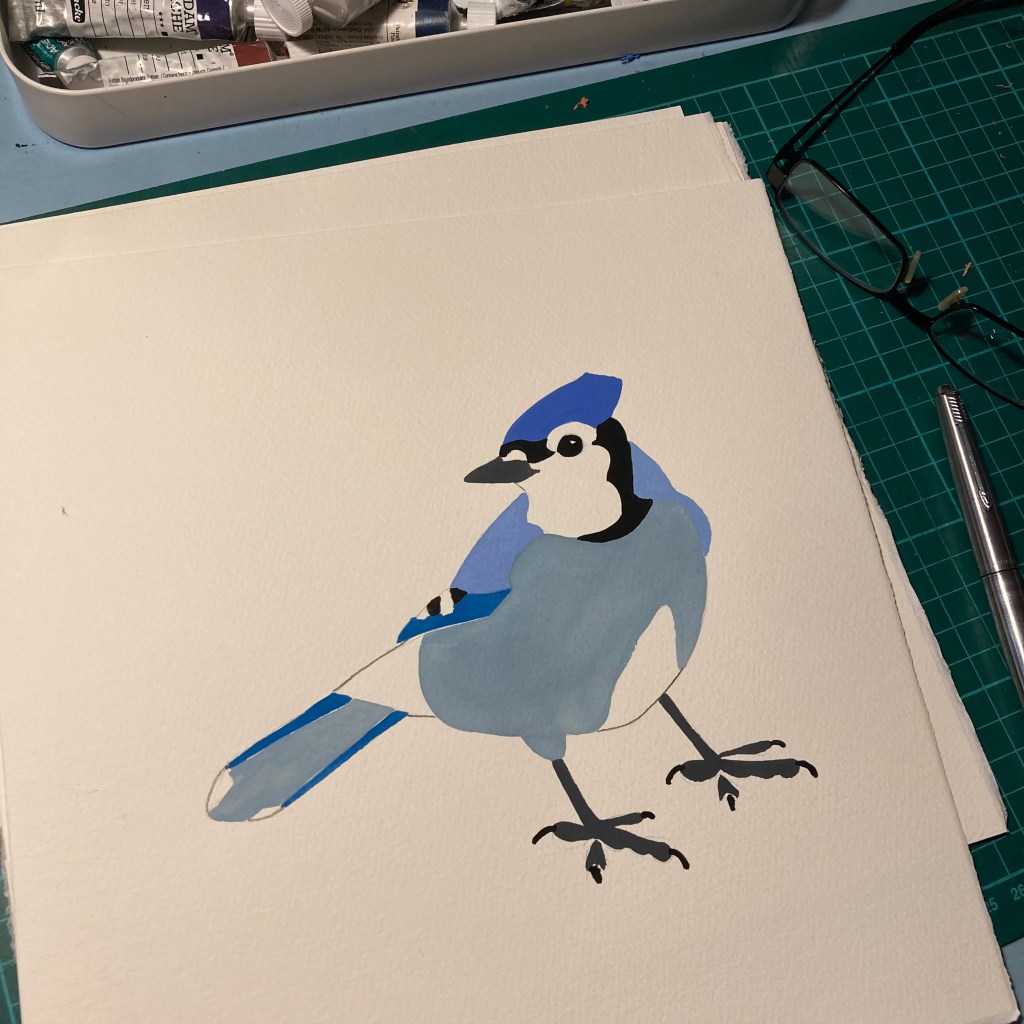
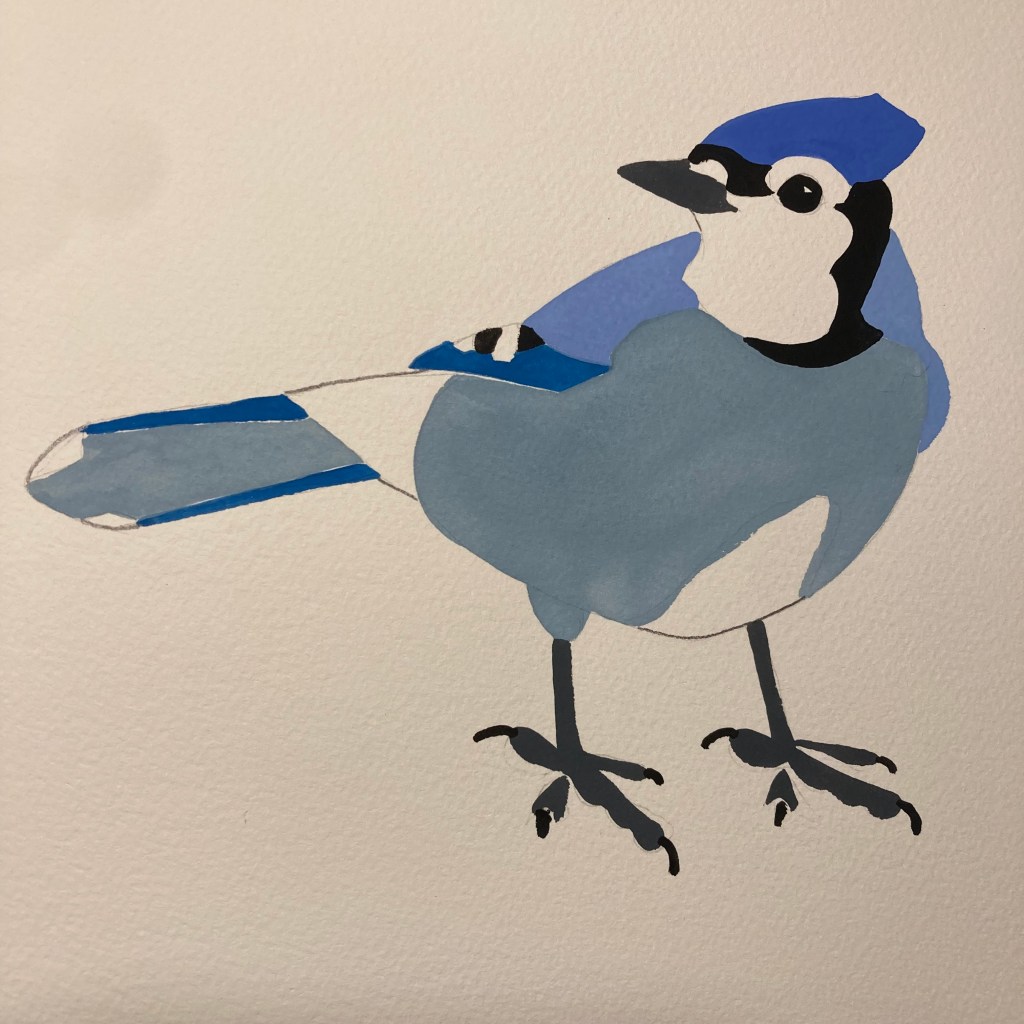
I have a lil project on the go at the moment so rather than do the actual Birdtober, I’m going to do my own version to encourage me to get the illustrations done. I have 26 plus a few extras to do so that should tie in nicely.
I’m starting with a beautiful Blue Jay. They have a lot of white on them, and rather than put them on a coloured background as I normally do, I’m drawing in the lines with pencil. I still have to scan them in and tidy them up but I quite like the white background.
I had to experiment with a lot of different blues to get the right shade, but ultramarine usually works for birds as it seems to be the nearest to the feather pigments. In fact, the pigment in their feathers is melanin which is brown, but special cells on the surface makes them scatter the light showing us the blue hues.
I drew some Blue Jays in my sketchbook ages ago from the fabulous Cornell Lab webcam, but this one had to fit into a circle so I’ve got him looking over his shoulder which is always a good way of getting a long bird into a smaller space, and one which I often look for when finding reference pictures for the illustrations in the birdwatching logbooks. In fact, I have to be careful that the birds don’t end up looking like they all need a session with a chiropractor.
Blue Jays, being corvids, are highly intelligent, expressive – and noisy. They have a complex social structure, and form tight bonds within their family group. Like our Eurasian Jays, they love acorns, and are attributed to initiating the reforestation following the last glacial period. They migrate in large flocks, although their migration patterns (and reasons) remain a mystery, with many birds staying in their territories all year round. Blue Jays occupy most of the states east of the Rocky Mountains in North America, their bright plumage and outgoing characters making them easy to spot.
I’m really pleased with how this one turned out.