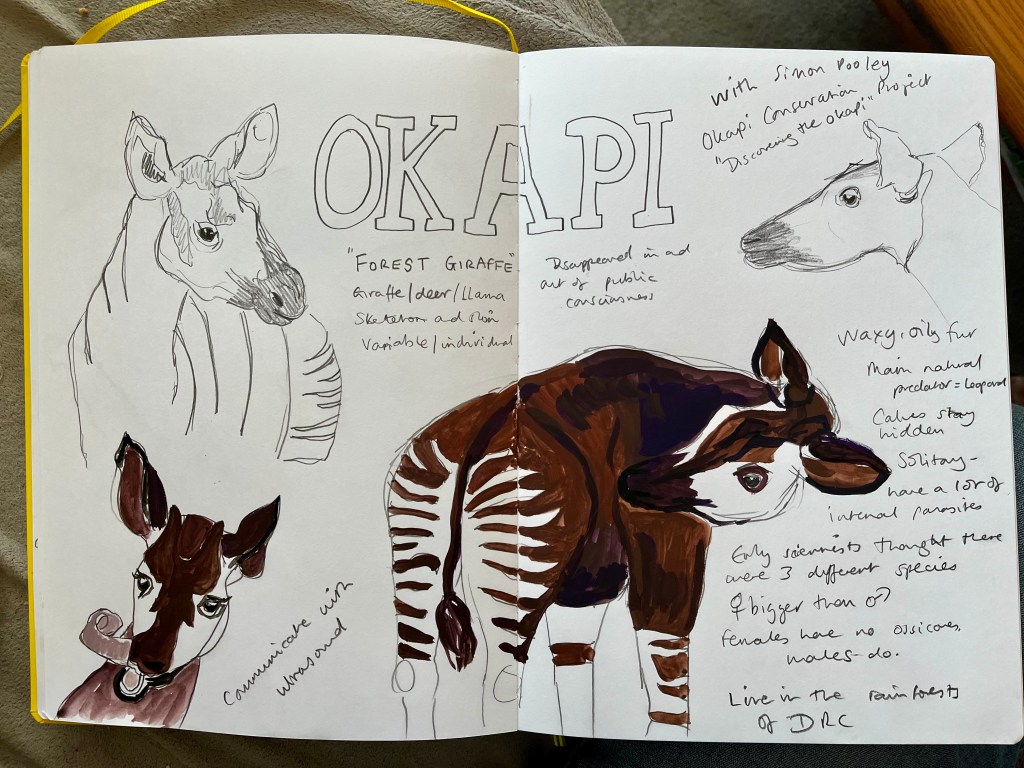
with Wild Life Drawing and Simon Pooley
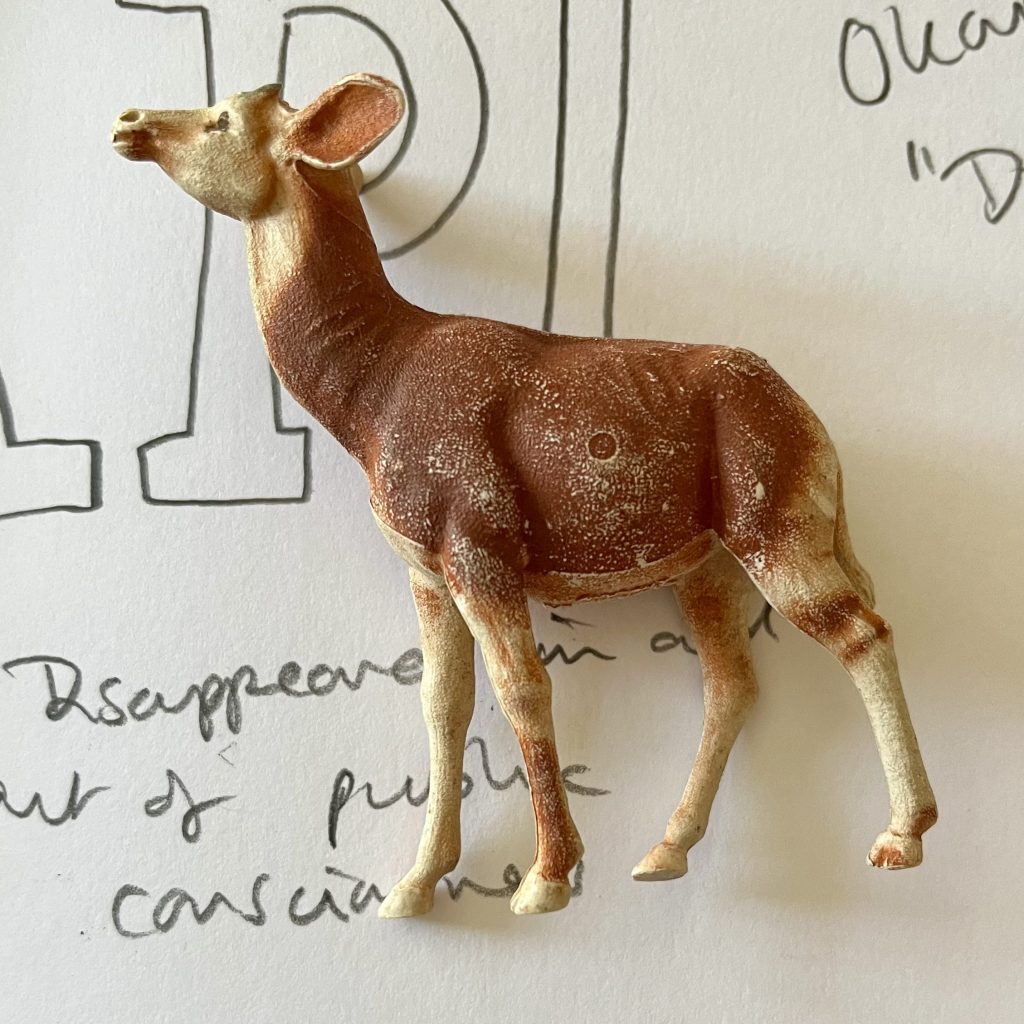
I have always had a soft spot for okapis ever since I acquired one in my Britain’s animal collection half a century ago. It used to have a pen (made from wooden blocks) on its own as I recognised that it wasn’t a giraffe, or a deer or a camel even though the okapi seemed a bit like all of them in one way or another.
Here he is; I know he’s a he because he’s got little horns, or ossicones, and only the males have them.
The drawing session was with Simon Pooley, author of Discovering the Okapi and illustrator and WLD Founder, Jennie Webber. Simon led a short presentation about how the okapi was “discovered” by Europeans, as it had been regarded as a mythical beast or unicorn thanks to the lack of evidence of its existence. Of course, indigenous people in the – now – Democratic Republic of Congo were well aware of the strange and elusive giraffid who roamed their extensive rainforests, but had never bothered to draw them or write down any facts as they didn’t feel the need to share such information: they knew it was there so why tell anyone else?
Enter the colonising Europeans and all of a sudden, knowledge and propriety is key, and the people who shared their environment with the okapis – and their wisdom surrounding them were completely disregarded and marginalised by the British and European explorers. Skins and skulls were sent back to Britain, and whole animals were reconstructed with these objects, with varying degrees of success. Due to the enigmatic lifestyle of okapis, live ones had not been observed so the attempts to work out how the completed taxidermy should be positioned was entirely guesswork.
I found this fascinating, especially in our current world of so much (too much?) information and a constant thirst for knowledge and understanding. Okapis are almost magical, and very little is known about their ecology. The Okapi Conservation Project works with local clans and communities to bring sustainable livelihoods to those living in the rainforest, with sustainable agroforestry and providing anti-poaching support and surveillance. Illegal mining also presents a problem, but by assisting the inhabitants of okapi country to keep watch over their lands, it helps everybody maintain this precious part of Africa and its wildlife for future generations.
On to the observational drawing, from reference photographs. Okapis have a waxy coat to help them stay dry in the constant humidity of the rainforest. Their 18-inch long tongue helps them browse the rich vegetation, and their markings are reminiscent of zebra, although they are no relation to horses. My drawings were slightly compromised by a) a lack of practise recently due to the demands of a young Labrador pup and b) that same Labrador pup chewing my toes while I was trying to participate in the Zoom.
They have a wonderful purple sheen to their brown coat, so I mixed violet with burnt umber for the darks, and burnt sienna for the lighter chestnut colour. They really are the most adorable animals.