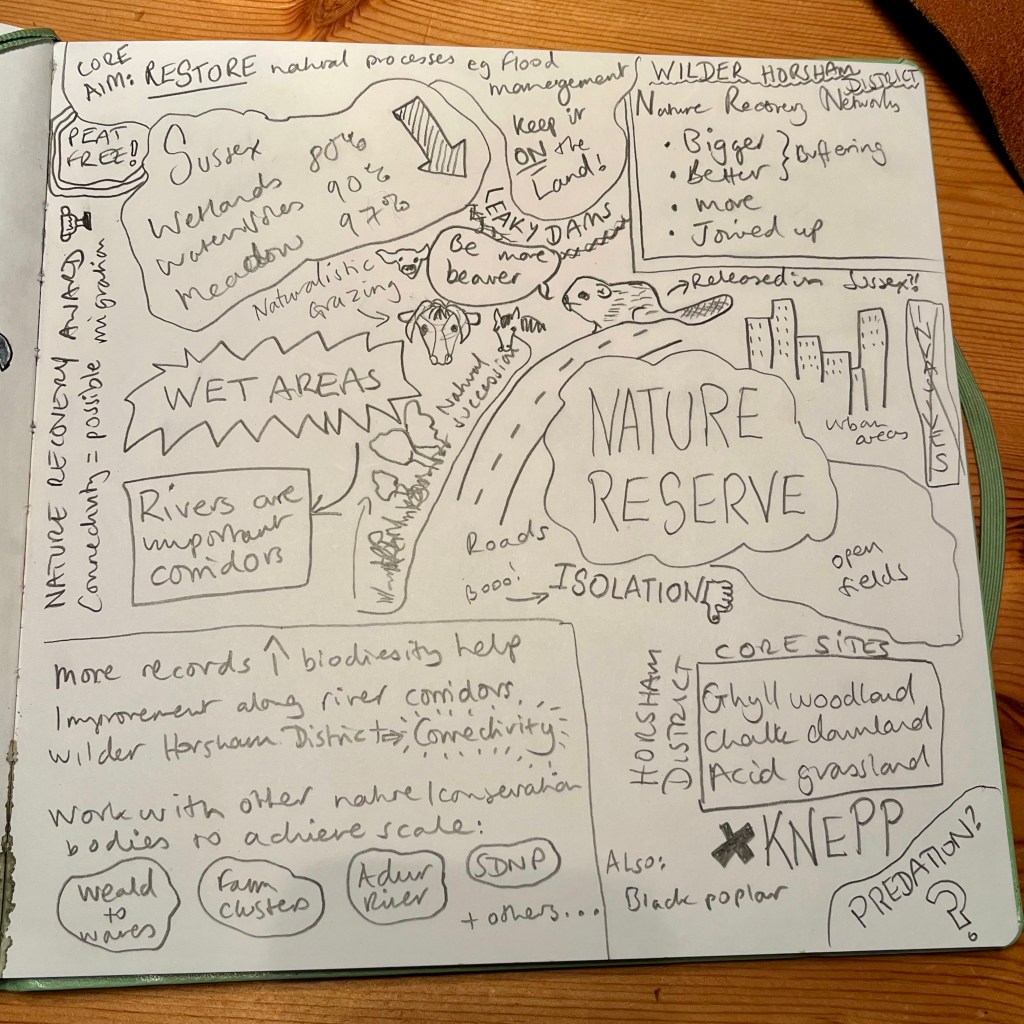
Last night I joined a webinar presentation by Wilder Horsham District courtesy of Sussex Wildlife Trust all about how this West Sussex council are working with various organisations to create a catchment-wide connectivity across the district. While protection of wildlife hotspots is of course essential, very few species live in nicely compartmentalised and distinct territories, and most of our green spaces have few, if any, means of safe passage between them. This creates bottlenecks and unnecessary competition within the area leading to reduced health and sustainability of these valuable sites.
By looking at the landscape as a whole and highlighting areas of wildlife conservation such as green spaces, mature trees, intact hedgerows, watercourses and even gardens, these layers can create a vision of how nature can potentially link up and create continuity for both species integration and cross-pollination. Rivers are a primary method of travel for numerous types of wildlife, but many are confined or constrained, reducing their worth in the landscape, or rather, not achieving their full potential. Most of our rivers have been straightened, and the vast majority of our fields contain land drains, thus rendering the movement of water across the land almost unrecognisable from a century ago. Wilder Horsham District are looking to rewet fields and remove drains, as well as create leaky dams and restore floodplains. In a highly-developed part of south-east England, this massively reduces the pressure on our beleaguered water infrastructure, especially during storms and unseasonal rainfall events. Beaver release is looking more likely for Sussex; there is a webinar on this specific topic too.
West Sussex is fortunate in having the pioneering Knepp Estate at its heart, and from this many other rewilding projects can hopefully gain traction, as well as pointing out to other districts across Britain about how to created a connected landscape. Weald to Waves is another initiative, and of course the South Downs National Park and the SWT Nature Reserves also feature heavily in this program.
The maxim of “Think Global, Act Local” is really apparent here, and something I am endeavouring to install in my own choices. I have just joined CPRE Sussex, and every county has one so take a look and see what’s happening in your area. This isn’t about “nimbyism” but about ensuring that nature has a seat at the table.
I took some notes in my sketchbook while I watched and listened. Here’s the page – let me know if you can make sense of it!