
I am still laid up with a cold/flu/Covid, so although I’m working on content for the Big Garden Birdwatch, I’m also treating myself to some sketchbook work. In my commitment to use more reference books rather than online images, I bought EQUUS by Tim Flach – I used to have the huge coffee table tome but this is the more manageable mini version, and although most of the pictures are too arty to be actual whole-horse reference images, they are spectacular and will be really useful for studies. I am still ruminating on some sort of poster about horses and how their role is becoming more relevant as we move to carbon-friendly ways of working in sensitive areas, and how they can influence the landscape. In addition, there are the crafts and skills associated with working horses that tie in with supporting a rural economy and reminding us of the rich heritage linked with a life before the combustion engine changed everything.
Our countryside would have been geared around the horse, with the loss of hay meadows directly linked to the reduction of farm horses needing the hay, and the loss of hedgerows and the tradition of laying them as tractors were fitted with flail mowers. Tractors work in straight lines, whereas horses can navigate wonky field margins. They also require grassland for grazing, and trees for shelter. Our landscape would be a much healthier, productive and peaceful space if horses were our main source of horsepower.
My background with horses
I first attended a riding school at the age of 8, then was lucky enough to own my own horse for a number of years before leaving for university. I never particularly enjoyed riding, always preferring the grooming, stable chores, and bond I had with the horse, and it wasn’t until I visited a ranch in Canada for a holiday that I understood the value of riding horses. Their endurance, awareness, and ability to cover terrain suddenly opened my eyes to how wasted horses are on recreational pursuits.
Horses today
Equines are thankfully enjoying a renaissance, and their use in rewilding projects as both grazers as well as for logging and other draught work means they are once again being seen in our landscape. And not just in fringe areas: I watched a video about a company in France using heavy horses to plough the ground between vines in the vineyards as just one example. It would be wonderful to see horses being used in mainstream agriculture – they work at a pace and in a way which is so much quieter and more contemplative and reassuring somehow.
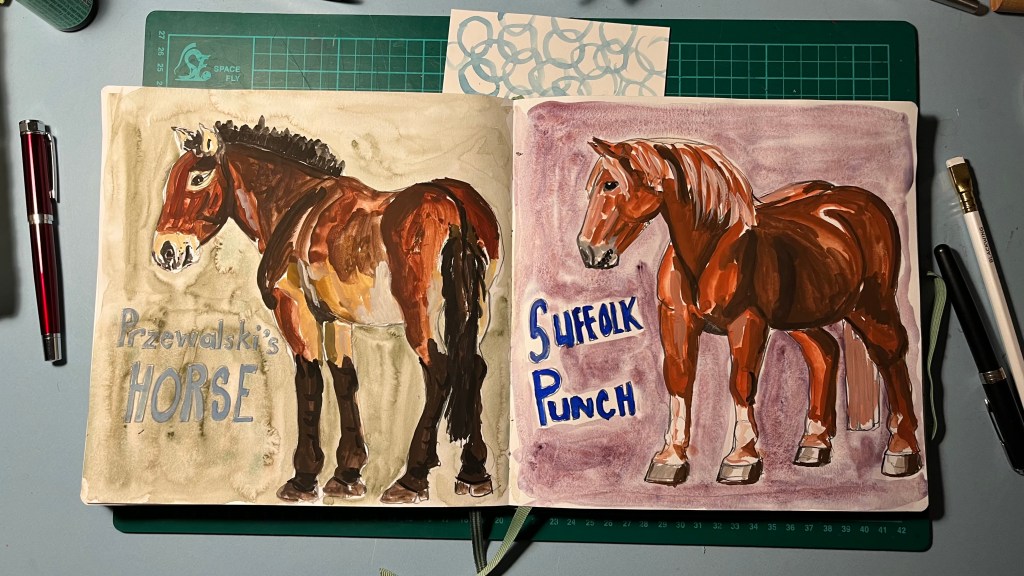
With this in mind I decided to paint two breeds of horse from my EQUUS book. There is a great photo of a Przewalski’s Horse in Mongolia (following on from the snow leopards), and they are deemed to be the closest relative of the ancient horse breeds. They have a front-heavy build and coarse coat reflective of their lifestyle in harsh conditions and rocky terrain.
The Suffolk Punch is from here in the UK. Suffolk Punches are a really rare breed, and unlike some of the other heavy horses, don’t have feathery legs. They are always chesnut, (that’s the correct East-Anglian spelling) with very little white, and have a stocky, four-square build, so basically the equine equivalent of a tank.
Method and materials
I really like how they turned out. I used my supergranulating watercolours for the background, and drew the main features with my Blackwing Pearl pencil (about a 2-3B) using the shape-finder method. This means looking for circles, triangles, and squares to build up the main body elements before topping off with the gouache. Personally I like seeing the pencil marks so if you want to clean the drawing up before adding the colour, you will need to use a regular 2H as the Blackwings have wonderfully rich graphite, even in the harder leads. They were great fun to paint!
I might try one of my favourite breeds next: the Fjord horse from Norway. Let me know if you’d like to see my drawing process.

